Parking during the Ghent Festivities takes planning. From 17 to 26 July 2026, more than 1.5 million visitors descend on Ghent's city centre for Europe's largest urban festival. This guide covers every parking option, current rates and smart alternatives so you can spend your time enjoying the festival instead of circling for a spot.
SparkSpot
Parking During the Ghent Festivities 2026: Your Complete Guide to a Stress-Free Visit
SparkSpot team
April 02, 2026
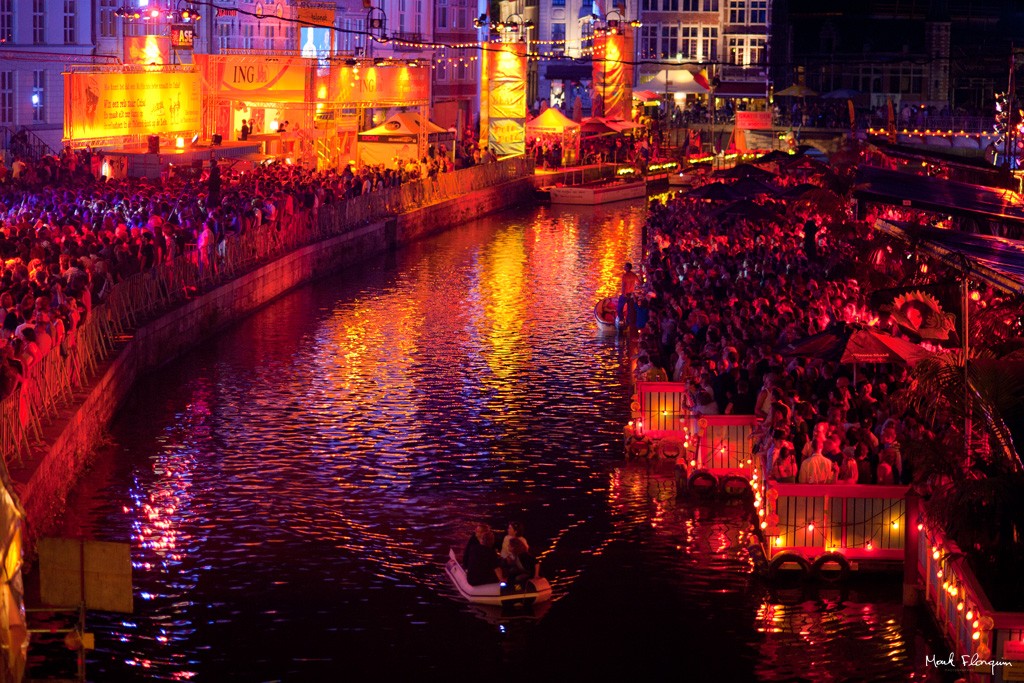
Why parking makes or breaks your Ghent Festivities experience
The Ghent Festivities transform the entire city centre into a sprawling stage. Free concerts echo across ten squares, street performers pop up on every corner and the smell of grilled sausages drifts through medieval alleyways. For ten consecutive days, Ghent becomes the cultural capital of Europe.
That transformation comes at a cost for drivers. Large sections of the city centre are closed to motor traffic. Temporary road closures redirect cars away from festival squares. Street parking spots that normally serve visitors disappear behind barriers and resident-only signs. The few available spaces fill up within the first hours of each festival evening.
Arriving without a parking plan means stress. You risk spending thirty minutes or more searching for a spot while the music has already started. The smart approach is to choose your parking location before you leave home, factoring in cost, distance and how late you plan to stay.
This guide walks you through every option. From the free Park and Ride at Flanders Expo to the cheapest city garages and clever alternatives that skip the car entirely.
Ghent Festivities 2026: dates, locations and what you need to know
The 2026 edition of the Ghent Festivities runs from Friday 17 July through Sunday 26 July. The festival has a history spanning more than 175 years and attracts visitors from across Belgium, the Netherlands, France and beyond. Admission to the vast majority of events is completely free.
Festival activities are spread across more than ten squares in the heart of Ghent. Korenmarkt and Sint-Baafsplein host the main stages with large-scale free concerts. Vlasmarkt is the go-to destination for night owls, Baudelopark offers a more relaxed atmosphere with world music and the Graslei and Korenlei waterfront provides the iconic backdrop that makes the festival uniquely Ghent.
For anyone arriving by car, there is a crucial detail: Ghent has a Low Emission Zone (LEZ) covering the entire city centre. Check lez.gent before you travel to confirm your vehicle is allowed. Older diesel vehicles (pre-2016 Euro 5 and below) and petrol vehicles (pre-2001 Euro 2 and below) are not permitted without a day pass. Fines start at 150 euros.
Most festival activities are free. Stages open in the afternoon and some squares keep the party going until the early morning hours. Choose your parking based on how long you intend to stay, not based on the first available gap you spot.
Park and Ride Flanders Expo: the best option for drivers
The single best parking decision you can make for the Ghent Festivities is driving straight to P+R Flanders Expo. This facility offers more than 2,800 free parking spaces right next to the E40 motorway. You park your car, board tram T1 and arrive in the city centre within fifteen minutes.
The biggest advantage during the festival is that tram T1 runs around the clock. During the afternoon, a tram departs every five minutes. In the evening and at night, the frequency drops to roughly every seven to ten minutes. No matter how late you stay at the Vlasmarkt or the Korenmarkt, there will always be a tram waiting to take you back.
Getting there is straightforward. Follow the E40 towards Ghent and take the Flanders Expo exit. The car park is signposted from the motorway. You bypass the city centre entirely, avoiding narrow one-way streets, road closures and the inevitable traffic congestion that builds up around the festival zone.
P+R Flanders Expo is completely free regardless of duration. Whether you park for two hours or twelve, you pay nothing. A single tram ticket costs a few euros. Compare that to a full day in the central garages at peak rates and the savings are substantial.
Prefer a guaranteed spot? Via SparkSpot you can find private parking spaces in Ghent available for advance reservation. Often cheaper than the city garages, with the certainty that a spot is waiting for you. No circling, no stress.
City garages during the Ghent Festivities: the 2026 peak tariff
If you prefer parking closer to the action, be aware of the new pricing structure that Ghent introduced from 1 April 2026. During the Ghent Festivities, the most central garages apply a peak tariff. This is the same rate charged on Saturdays and during other major events.
The Vrijdagmarkt, Sint-Michiels, Reep and Ramen garages form the most expensive cluster. During daytime peak hours (7am to 7pm) the rate is 4 euros per hour, capped at 34 euros for 24 hours. The night tariff (7pm to 7am) is 2 euros per hour with a 9 euro maximum. During Ghent Festivities evenings (7pm to 7am), the standard tariff of 3 euros per hour applies with a cap of 31 euros.
Savaan garage sits in a slightly cheaper bracket at 2.50 euros per hour with a daily maximum of 20 euros. During the Ghent Festivities, the daytime standard rate also applies during the evening hours.
Important: since 7 January 2026, Ghent's city parking machines no longer accept cash. You must pay by bank card (contactless or chip) or through a parking app such as 4411, EasyPark or Yellowbrick. Plan accordingly.
Sint-Pietersplein and Tolhuis: cheaper and calmer
Visitors willing to walk an extra ten minutes will find significantly better value at Sint-Pietersplein and Tolhuis. These garages sit in the southern part of the centre, roughly 15 to 20 minutes on foot from the Korenmarkt. They belong to a separate pricing cluster and are noticeably cheaper.
The hourly rate is a flat 1.80 euros, regardless of whether it is a weekday or an event day. The 24-hour maximum is 12.80 euros. The night tariff is also 1.80 euros per hour capped at 7 euros. Compare that to the 34 euro peak rate in the central garages and the difference speaks for itself.
Sint-Pietersplein garage has approximately 600 spaces and sits next to the square of the same name, within walking distance of Sint-Pieters railway station. The walk to the festival centre takes you through the lively Overpoort student district, which during the Ghent Festivities becomes an extension of the party itself.
For an evening visit of six hours, you would pay a maximum of 10.80 euros here versus 24 euros in the centre. That is money better spent on a round of Gentse Gruut beer at one of the festival terraces.
Ledeberg and Het Getouw: park outside the centre
Budget-conscious visitors should consider Ledeberg and Het Getouw, the cheapest among Ghent's city-managed garages. They sit further from the festival heart, but the prices reflect that distance and you avoid the congested streets around the inner city entirely.
Ledeberg charges 1.20 euros per hour during the day with a maximum of 9.60 euros. In the evening, at night and on Sundays the rate drops to 1 euro per hour capped at just 5 euros. That makes Ledeberg particularly attractive for evening festival visits.
Het Getouw is even more affordable at 1 euro per hour during the day (maximum 8 euros) and the same evening rate of 1 euro per hour with a 5 euro cap. A full evening of parking here costs less than a single hour in the central garages.
From Ledeberg you can reach the city centre in about 20 minutes on foot or 10 minutes by bicycle. Het Getouw is slightly further but well connected by public transport. Both garages are ideal if you plan to leave the car and enjoy the rest of the evening on foot.
Payment and LEZ: what to know before you travel
Ghent has operated a Low Emission Zone since 2020 covering the entire city centre within the R40 ring road. Every city garage in the centre falls within this zone. Check lez.gent before departure to verify your vehicle is permitted. A day pass for non-compliant vehicles costs 35 euros.
Visitors from the Netherlands should pay particular attention. Belgian LEZ rules differ from Dutch environmental zones. A Dutch Euro 4 diesel that is perfectly legal in Rotterdam may trigger a 150 euro fine in Ghent. Repeat offenders face fines up to 350 euros. Check your licence plate online before you travel.
Regarding payment: all Ghent city garages have been fully cashless since January 2026. Pay by bank card (contactless or chip) or via parking apps such as 4411, EasyPark or Yellowbrick. On-street parking in the red and orange zones has also become payable on Sundays and public holidays since April 2026. During the Ghent Festivities, however, most on-street spaces in the centre are unavailable.
One more consideration: the Ghent circulation plan means you cannot simply drive from one side of the centre to another. The city is divided into sectors and through-traffic is blocked by camera-controlled cuts. If you miss the entrance to your chosen garage, you may need to drive back out to the R40 ring road and re-enter via a different route. Know your route in advance.
Alternatives to driving: tram, train and bicycle
The car is not the only way to reach the Ghent Festivities, and during the festival it is often not the most practical. De Lijn deploys additional capacity on tram and bus routes throughout the event. Tram T1 operates 24 hours a day between Flanders Expo and the city centre. Special Ghent Festivities night buses return visitors from the centre to the P+R locations, departing from Gent Zuid at 00:45, 02:30 and 04:15.
By train, Gent-Sint-Pieters station is the natural starting point. An IC train from Brussels takes 30 minutes and departs every half hour. From Antwerp the travel time is similar. From the station you can walk to the Korenmarkt in 20 minutes or hop on tram T1 for two stops.
The bicycle may be the smartest transport choice during the Ghent Festivities. The city provides staffed bicycle parking at three locations: Sint-Michiels parking (levels minus 1 and minus 2), Sint-Lievenscollege and Maaseikstraat/Bisdomplein. All three are open around the clock and manned. Your bike is safe while you celebrate.
Blue bike offers shared bicycles at the station and at various points across the city. A ride costs just a few euros. Combine the train with a Blue bike and you eliminate the need for a car altogether. Keep in mind that bicycle parking can fill up during peak moments. Arrive early or consider bringing your own bike.
The five biggest parking mistakes at the Ghent Festivities
First mistake: driving into the centre without a plan. The chances of finding an on-street parking space in the centre during the Ghent Festivities are virtually zero. Numerous streets are closed and the remaining spots are reserved for residents.
Second mistake: assuming you can pay with cash. Every city garage has been cashless since January 2026. Without a bank card or parking app you will be stuck at the barrier.
Third mistake: forgetting the LEZ. Visitors from the Netherlands in particular underestimate the Ghent Low Emission Zone. An older diesel that is perfectly fine at home could trigger a 150 euro fine here. Check lez.gent before departure.
Fourth mistake: arriving too late. City garages fill up early on busy festival evenings. Anyone arriving after 8pm will often find the central garages full. Leave before 5pm or head directly to P+R Flanders Expo.
Fifth mistake: not thinking about the return journey. After midnight, public transport is limited apart from tram T1. If you park in a city garage and stay late, the night tariff applies. P+R Flanders Expo is free regardless of the time.
Stay longer, leave smarter
The Ghent Festivities are ten days of magic in one of the most beautiful cities in Flanders. Do not let parking become an obstacle. Choose P+R Flanders Expo for free, stress-free parking or reserve a spot near the centre in advance.
On SparkSpot you can find private parking spaces in Ghent available for advance reservation. Often cheaper than the city garages, with the certainty that a spot is waiting for you. No circling, no stress, just festival.
Frequently Asked Questions
Where is the best place to park during the Ghent Festivities?
P+R Flanders Expo on the E40 motorway is the best option. It is free, offers more than 2,800 spaces and tram T1 takes you to the centre in fifteen minutes, running 24 hours during the festival. For those who prefer being closer, Sint-Pietersplein and Tolhuis garages charge just 1.80 euros per hour with a 12.80 euro daily maximum.
How much does parking cost in central Ghent during the Ghent Festivities?
The central garages (Vrijdagmarkt, Sint-Michiels, Reep, Ramen) charge a peak rate of 4 euros per hour during the day, capped at 34 euros for 24 hours. Night rates are 2 euros per hour with a 9 euro maximum. Cheaper alternatives include Sint-Pietersplein (1.80 euros per hour) and Het Getouw (1 euro per hour).
Can I drive into Ghent city centre during the Ghent Festivities?
Ghent has a Low Emission Zone (LEZ) covering the entire centre. Check lez.gent to verify your vehicle is permitted. Older diesel and petrol vehicles require a day pass (35 euros). Additionally, extra streets are closed to traffic during the festival. City garages remain accessible, but expect additional congestion and diversions.
Can I park for free during the Ghent Festivities?
Yes, P+R Flanders Expo offers more than 2,800 free parking spaces on the E40. You combine this with tram T1 which runs 24 hours a day during the Ghent Festivities. The tram ride takes fifteen minutes. It is by far the cheapest and most convenient option. Free on-street parking in the centre is virtually impossible during the festival: most spaces are closed off or reserved for residents.
WRITTEN BY
SparkSpot team
The SparkSpot team shares their expertise to provide the latest tips on renting parking spaces.Related posts
SparkSpot
Een garagebox verhuren? Een compleet overzicht!
Maart 05, 2024
SparkSpot
Een overzicht: Btw bij het verhuren van een garage of staanplaats
Maart 12, 2024
SparkSpot
Een garagebox kopen om te verhuren: is het een slimme investering?
April 15, 2024
SparkSpot
Hoeveel kun je verdienen met het verhuren van een garagebox?
Mei 10, 2024

